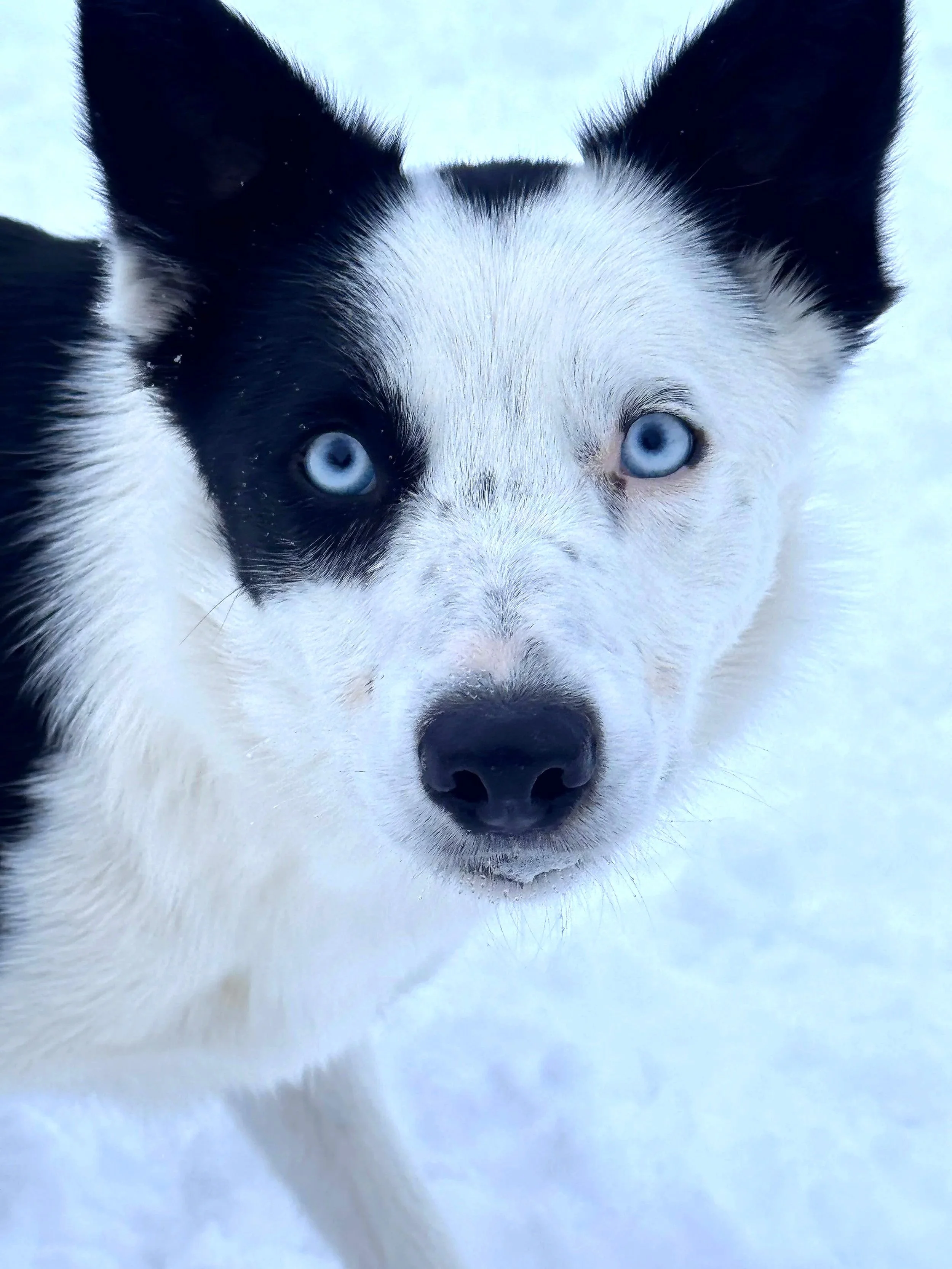
Henam
Henam is a compound of three different words spanning three different cultures and three separate domains of intention that triangulate our strivings. Ἥρως, from Ancient Greek, meaning “hero, i.e., an epic warrior from the Age of Heroes and/or a cult figure with powers for good and evil worshipped at a hero shrine or tomb.” Wœ̄nan, from Old English, meaning “to ween, suppose, think, imagine, opine, believe…to hope, expect, look for.” (2) ᎠᎹ, from Cherokee, meaning “water” which is used here in a purely figurative, “reported,” and non-literal sense to honor traditional rules regarding the names of natural entitites. What we aim for are heroic figures not merely of physical prowess but of thought and hope who may live and move and have their being and their power in the inimitable way of water.
The founder of Henam Border Collies is an experienced dog rehabilitator who specialized in extreme aggression and fear cases before reentering academia to explore questions of the formalizability of nonstandard cognition. Today, our founder works at the intersection of artificial intelligence, mathematical logic, linguistics, and biomimetic engineering. The study of the Working Border Collie, and Henam’s contribution to it, is the natural development of foundational questions. What is the cognitive architecture of the working dog and can such an architecture be formalized sufficiently to create a model of interspecies communication?
This combination of hands on training experience and cutting edge research makes Henam unique. We are not a traditional ‘kennel’ and do not breed for profit. Profitability is only possible if investment in one’s dogs is minimal and the number of dogs produced stupendous. We always begin from the assumption that puppies will remain with us for as long as necessary to ensure their proper flourishing and, subordinate to this first principle, the achievement of the research aims; ongoing evaluation and management considerations determine whether littermates may require a different environment to reach their full potential. For this reason, we typically plan a single litter (or less) per year and have no predictable timeline for puppy placements. Most breeders place dogs at 8-10 weeks, because very young puppies are cute enough to sell, and adequate long-term management of an entire litter constitutes more than a full time job.
At Henam, each puppy receives a minimum of 200 hours of structured training and neurological stimulation, beyond routine care, manners, crate training, or group play. This training concerns the development, intensification, and shaping of the herding instinct which we use to deescalate fear responses (e.g. to herd when confronted with sudden noises like gunshots or fireworks), to ensure near bulletproof recall, and to elicit situational obedience where appropriate. Henam has developed a number of methods to work dogs off livestock which require no treats or toys. Each puppy has learned from at least five weeks old to activate their herding instinct on cue, and this activation may be applied to all sorts of objects in all manner of circumstances. Only with the instinct at the handler’s disposal can a working dog continue to thrive in the absence of livestock. Exerting an extraordinary amount of pressure on puppies to obey a litany of commands is the surest way to turn an animal into a robot, and the working drive into a neurosis. From the instinct everything flows and to the instinct everything must return. It is the vehicle of partnership, of clarity, of fulfillment, and obedience.
Henam dogs are not pets in the traditional sense. They occupy a liminal space between domesticated dogs and wild canids (think wolves). The herding instinct cannot be fully domesticated, for its origins are found not in the agrarian projects of humanity, but in the wild, sometimes lonely, hunter. When you adopt a working dog, especially a Working Border Collie, you are adopting a partner and not a pet, a status symbol, a chance to self-actualize, a diversion for free time, or a servant. Such partnership requires, absolutely and completely, that each member strives to build mutual understanding for the life of the dog. For the human, this means developing structure and discipline without the fracture of a dog’s confidence; it entails daily engagement with the insatiable hunger of the herding instinct. For the dog, this means loyalty, joy, patience, determination, love.
Strong preference is, therefore, given to working and companion homes willing to commit to this once in a lifetime partnership where growth is nonlinear and co-dependent.